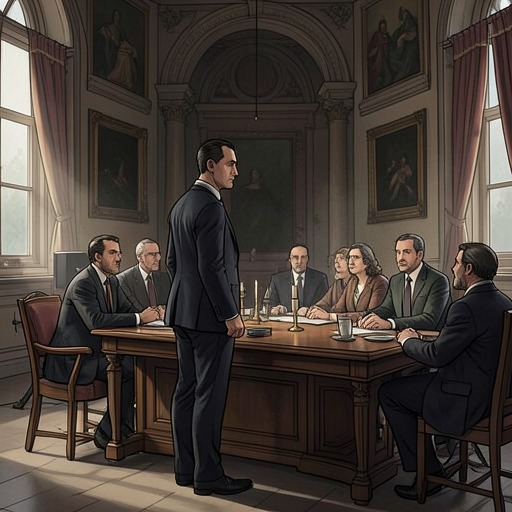
Poirot reveals Inglethorp’s alibi
The Mysterious Affair at StylesPoirot reveals Inglethorp’s alibi when Alfred Inglethorp appears to be incriminated by a chemist’s identification and by the claim that he purchased strychnine. At a gathering at Styles Court, Poirot first states plainly that Inglethorp is suspected of poisoning his wife, then reverses the apparent case against him: the man who bought the poison was not Inglethorp, whom five witnesses can place with Mrs. Raikes miles away. The episode turns a seemingly conclusive accusation into a warning about evidence manufactured to mislead.
The Accusation and Its Apparent Proof
Before this public disclosure, the investigation’s working account is that Mrs. Inglethorp died of strychnine poisoning, presumably administered in her coffee. Poirot has already questioned how well she ate the previous evening and asked when the coffee was served, attending to the timing of the supposed route of poisoning rather than accepting it as a settled fact.
At the inquest, however, a young witness identifies Mr. Inglethorp as the person who bought the strychnine. The room falls silent, and attention turns to Alfred, who remains seated and appears astonished. Taken together with suspicion surrounding his absence from home, the identification makes the case against him seem compelling. Poirot sees a problem in that very neatness: he tells Hastings that the excuse for Inglethorp’s absence is obviously contrived, but that it could point either to foreknowledge of the crime or to some independent reason for being away. Suspicion, he insists by his method, does not resolve which explanation is true.
Poirot’s Public Intervention
At Styles Court, Poirot takes the initiative in front of the assembled household, to the surprise of those present. He announces that he has called them together concerning Alfred Inglethorp and tells Alfred directly that he is suspected of poisoning his wife. When Alfred protests his innocence, Poirot says he must speak on his behalf. The announcement is both a dramatic reversal and an evidentiary claim: Poirot does not merely express private doubt but offers a testable account of where Alfred was.
Poirot states that the purchaser at the chemist’s shop at six o’clock on Monday was not Alfred. At that hour, he says, Alfred was escorting Mrs. Raikes home from a neighbouring farm. Five witnesses can attest to seeing the pair at six or shortly afterward, and Abbey Farm, Mrs. Raikes’s home, lies at least two and a half miles from the village. Poirot presents a list of the witnesses’ names and addresses for verification. His conclusion is categorical, but its force rests on evidence others can check rather than on his authority alone.
The Meaning of the Alibi
The alibi defeats the identification that had seemed to tie Alfred to the purchase of the poison. James Japp accepts Poirot’s intervention with relief, acknowledging that arresting Alfred on the existing case would have been a serious mistake. He asks why Alfred did not give the account at the inquest; Poirot begins to explain that a rumour was involved, while Alfred calls it malicious and untrue. The exchange makes clear that the truth of the alibi and the timing of its disclosure are separate questions: the witnesses can clear Alfred of the purchase, while the reason for withholding that explanation remains entangled with the household’s suspicions and the rumour surrounding him.
Poirot’s broader reasoning is that evidence can become less persuasive, not more, when it is too complete. After leaving the inquest, he calls the case against Alfred excessively conclusive and argues that a criminal has manufactured it so cleverly that the effort has defeated its purpose. Vague, intangible evidence would have been difficult to disprove; a tightly constructed case can be broken by one contradiction. The alibi supplies that contradiction and loosens the net around Alfred, but it does not identify the actual murderer.
Reversal, Limits, and Later Context
The episode is a crucial correction to an early reading of the case, not its solution. Later in the investigation, John Cavendish questions the theory that Dr. Bauerstein would have demanded a post-mortem if he had been responsible, and Poirot continues testing apparent evidence against alternative explanations. At John’s trial, handwriting experts agree that the signature attributed to Alfred in the chemist’s poison register is not Alfred’s, while allowing that it could be a clever counterfeit. The identification of a purchaser and the appearance of a signature thus prove vulnerable to disguise and forgery; neither can safely be treated as independent confirmation of Alfred’s guilt.
Poirot’s final explanation also revises the early assumption that the poison was administered in coffee. A damp stain on the carpet, its coffee odour, and china fragments lead him to infer that a cup was broken; he then distinguishes that reconstruction from the known fact that the cocoa contained no strychnine and that the coffee was not drunk. He identifies Mrs. Inglethorp’s medicine as the medium, explaining that the fatal strychnine was already in the mixture prescribed by Dr. Wilkins. He further states that the crime was intended for Monday evening, but Mrs. Inglethorp’s missed dose delayed the fatal one by twenty-four hours. A letter in the murderer’s handwriting becomes the last link in his chain. These later disclosures do not cancel the alibi; they reveal why the initial accusation was so misleading and show that the case against Alfred was one constructed appearance within a larger plot.
Narrative Significance
Because Arthur Hastings narrates the investigation, the alibi arrives not as an abstract correction but as a scene of public suspense: Poirot names the suspect, Alfred reacts, and the detective then speaks for the man under suspicion. Hastings’s account conveys how readily the room’s attention had settled on Alfred and how completely Poirot’s announcement changes the direction of that attention. The reader, like the assembled company, must revise a judgment formed from apparently direct testimony.
The episode also establishes a distinction central to Poirot’s method: a plausible clue is not the same as proof, and the apparent accumulation of evidence does not guarantee that its pieces are genuine or independent. Five witnesses and a stated distance provide a check on the accusation; later, the false signature, the questionable placement of evidence, and the corrected account of the poison’s medium further expose the hazards of premature certainty. The alibi clears Alfred of the specific purchase, forestalls a wrongful arrest, and leaves the central question open until Poirot can connect the remaining evidence.